Hera / Juno
Queen of the gods, goddess of marriage
Hera is the queen of Olympus and the goddess of marriage, women, and childbirth — the only married goddess among the Olympians. Majestic, proud, and famously jealous, she spent her long marriage to Zeus defending its honour against his endless affairs, and her anger shaped the lives of heroes from Heracles to the Trojans.
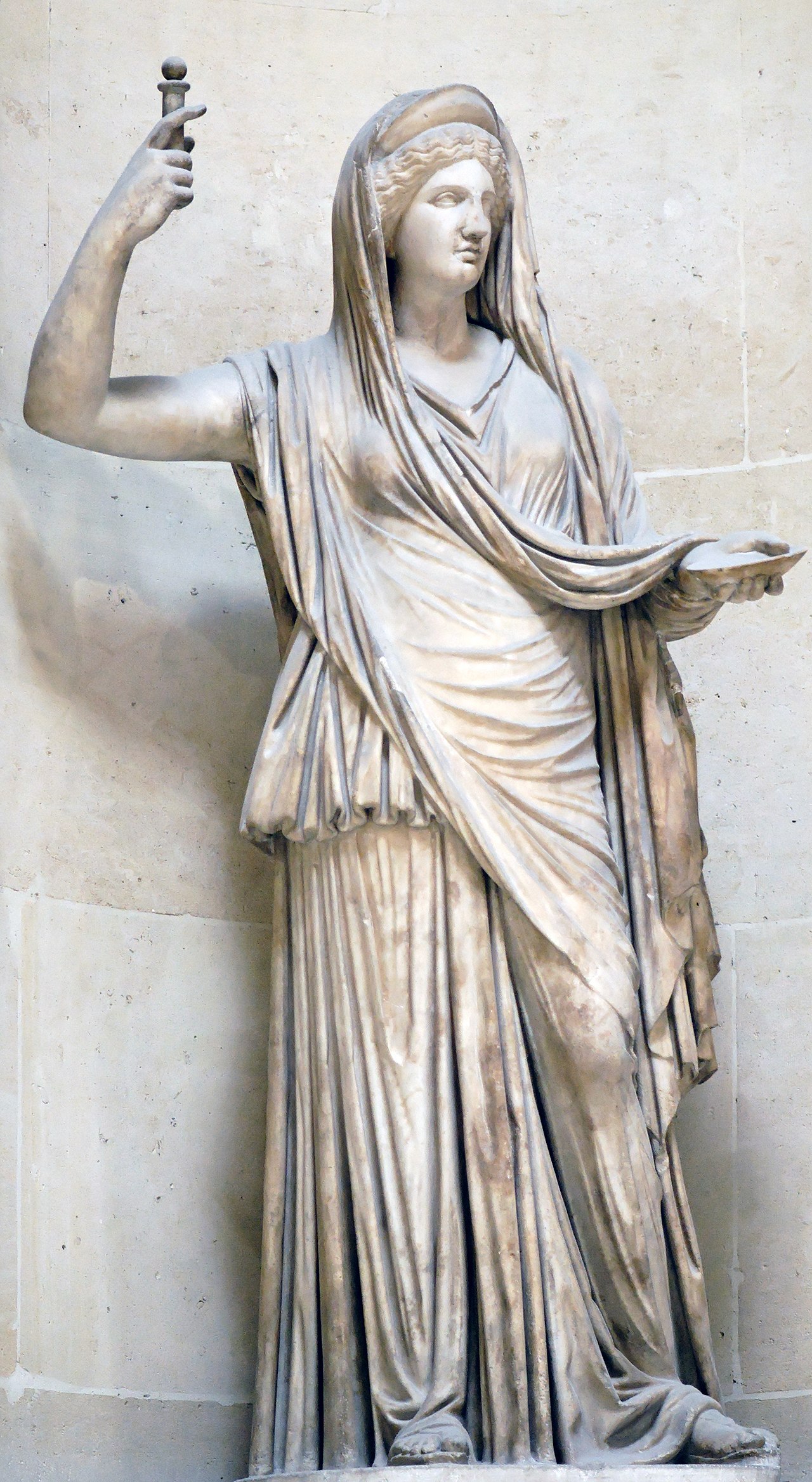
How they were born
Hera was the daughter of the Titans Cronus and Rhea, and like her brothers and sisters she was swallowed by her father the moment she was born. When Zeus forced Cronus to disgorge his children, Hera emerged and took her place among the Olympians. According to Homer, she was then raised far from the fighting of the Titan war by the sea god Oceanus and his wife Tethys, who brought her up as their own daughter.
The greatest stories
The Judgement of Paris
At the wedding of Peleus and Thetis, the goddess Eris threw down a golden apple inscribed 'to the fairest', and Hera, Athena, and Aphrodite all claimed it. Zeus refused to judge between them and sent the three goddesses to Paris, a shepherd prince of Troy. Each offered him a bribe: Hera promised him power and kingdoms, Athena promised wisdom and victory in war, and Aphrodite promised him Helen, the most beautiful woman in the world. Paris chose Aphrodite — and Hera's fury at the insult helped drive the Greeks to destroy Troy in the ten-year war that followed.
Hera Against Heracles
Hera's greatest enemy was Heracles, the hero son of Zeus and the mortal Alcmene, whose very name means 'glory of Hera'. Before he was even born, she delayed his birth and hurried the birth of his cousin Eurystheus, so that Eurystheus, not Heracles, would inherit the throne. When the baby Heracles lay in his cradle, she sent two serpents to kill him — but the infant strangled them with his bare hands. Later she drove him mad, and the labours he performed to atone became the famous Twelve Labours of Heracles.
Io and Argus
When Zeus fell in love with the priestess Io, he turned her into a white cow to hide her from Hera. Hera was not fooled: she admired the beautiful cow and asked Zeus to give it to her as a gift, then set the hundred-eyed giant Argus to guard it — Argus never slept, because some of his eyes were always open. Zeus sent Hermes to rescue Io, and Hermes charmed Argus to sleep with music and stories, then cut off his head. To honour her faithful watchman, Hera set his hundred eyes into the tail feathers of her peacock, which is why the peacock's tail is covered in eyes to this day.
Hera and Leto
When Leto, pregnant by Zeus with the twins Apollo and Artemis, was about to give birth, Hera was determined that no land would shelter her. She sent the serpent Python after Leto and made every country turn the wandering goddess away, while she held back Eileithyia, the goddess of childbirth, so that Leto's labour dragged on for nine days and nights. At last the floating island of Delos, which belonged to no land at all, took Leto in, and there, under a palm tree, Apollo and Artemis were born.
The Cuckoo Courtship
Before she would marry him, Zeus had to win Hera — and he did it with a trick. One day he conjured a great storm and turned himself into a small, shivering cuckoo, which fluttered down into Hera's lap seeking shelter. She took pity on the cold, frightened bird and held it close to warm it — and at that moment Zeus turned back into himself and asked for her hand. She laughed, and agreed, and their wedding, celebrated on the island of Samos, lasted for days, with all the gods in attendance and the earth itself blooming in honour of the marriage.
Family & connections
Symbol, animal & weapon
Fun facts
- The month of June is named after Juno, Hera's Roman name — which is one reason June became the traditional month for weddings.
- The 'eyes' on a peacock's tail are, in myth, the hundred eyes of Argus, the giant Hera set to watch Io — she placed them on her sacred bird after Hermes killed him.
- The hero Heracles' name means 'glory of Hera', which is deeply ironic, since Hera spent his whole life trying to destroy him — and in the end he married her daughter Hebe.
- The great Heraion of Samos, her temple on the island where she was said to have married Zeus, was one of the largest temples in the ancient Greek world.
- Homer calls Hera 'cow-eyed' — the cow was sacred to her, and she is often shown with a cow, a cuckoo, or her peacock beside her throne.
Gallery — sculpture & art


