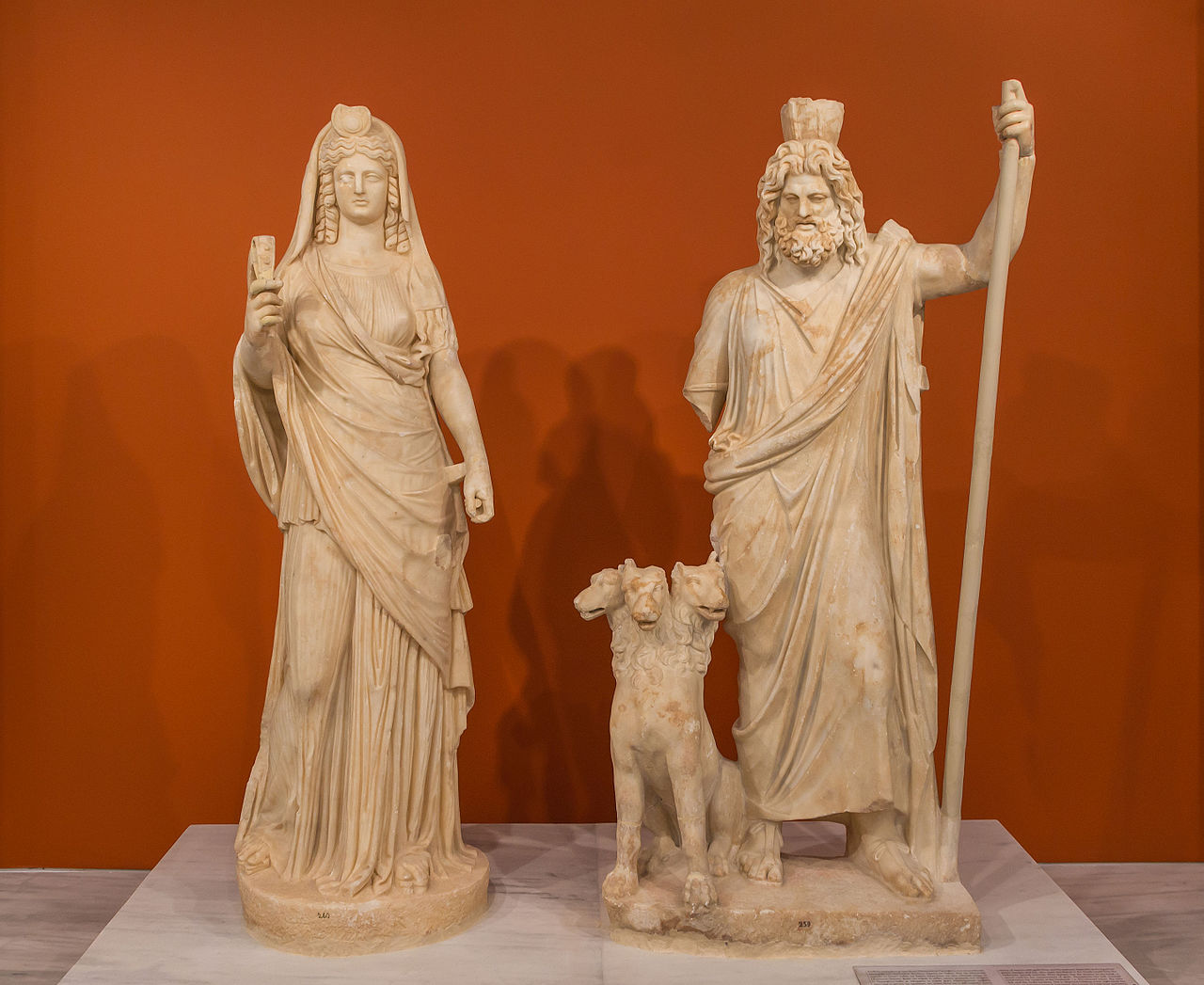
Hades / Pluto
King of the underworld, god of the dead
Hades is the stern, unseen king of the underworld, ruler of all the dead and guardian of the earth's buried riches. He is not death itself — that is Thanatos — but the lord of the shadowy kingdom below, feared and respected by gods and mortals alike, and the Greeks were so wary of him that they often avoided speaking his name at all.

How they were born
Hades was the eldest son of the Titans Cronus and Rhea, and like his brothers and sisters he was swallowed by his father the moment he was born. He lived inside Cronus until his youngest brother Zeus forced their father to disgorge them all. After the Olympians defeated the Titans in the ten-year Titanomachy, the three brothers drew lots for the world: Zeus won the sky, Poseidon the sea, and Hades the underworld — the dark realm of the dead, which came to bear his name.
The greatest stories
The Abduction of Persephone
Hades wanted a queen, and with Zeus's secret consent he chose Persephone, the daughter of Demeter. One day, as she gathered flowers in a meadow, the earth split open and Hades burst out in his golden chariot, seized her, and carried her down to his kingdom. Her mother Demeter's grief stopped all growth on earth until Zeus sent Hermes to bring Persephone back. But before she left, Hades gave her pomegranate seeds to eat, and because she had tasted the food of the dead, she was bound to return to him for part of every year — the winter months, when the earth mourns with Demeter.
Orpheus and Eurydice
When the singer Orpheus lost his wife Eurydice to a snakebite, he walked alive into the underworld and charmed its rulers with his music — even the Furies wept, and Cerberus wagged his tail. Hades agreed to let Eurydice go, on one condition: Orpheus must not look back at her until they had both reached the sunlight. At the very threshold, desperate to be sure she was really there, Orpheus turned — and Eurydice slipped back into the dark forever, whispering farewell.
Heracles and Cerberus
The last of Heracles' Twelve Labours was the most terrifying: to bring Cerberus, the three-headed hound of the underworld, up to the world of the living. Hades agreed, but only if the hero used no weapons — he must overpower the beast with his bare hands. Heracles wrestled the monstrous dog, whose tail was a serpent and whose mane writhed with snakes, and dragged it up to King Eurystheus, who was so frightened that he hid in a great bronze jar. Then Heracles returned Cerberus safely to his post at the gates of the dead.
Theseus and Pirithous
The heroes Theseus and Pirithous were so bold that they journeyed to the underworld to carry off Persephone herself and make her Pirithous's bride. Hades welcomed them with a feast — but the moment they sat down on his chairs, serpents coiled around their legs and held them fast, and they were trapped. Theseus was rescued years later by Heracles, who tore him free, but Pirithous, whose crime had been the greater, was left sitting in the underworld forever.
Sisyphus Cheats Death
Sisyphus, the craftiest of kings, twice cheated Hades. When the death-god Thanatos came for him, Sisyphus chained him up, and for a while nobody on earth could die at all. Later, when he did die, he tricked Persephone into letting him return to the living to arrange his own funeral — and then simply refused to come back. When Hades finally got him back for good, he gave him a punishment to match his cunning: forever rolling a great boulder up a hill in the underworld, only for it to roll back down each time he neared the top.
Family & connections
Symbol, animal & weapon
Fun facts
- The Greeks avoided saying Hades' name out loud, and instead called him Plouton — 'the wealthy one' — because the earth beneath us holds gold, silver, and fertile soil. His Roman name, Pluto, comes from this.
- Hades is not the god of death: that is Thanatos. Hades is the king of the dead — a ruler and judge, not a killer.
- The dwarf planet Pluto was named after him in 1930, on the suggestion of 11-year-old Venetia Burney of Oxford, who thought the cold, dark, distant world suited the god of the underworld.
- His Helm of Darkness made its wearer invisible. He lent it to Perseus to help him slay Medusa, and Athena wore it in the Trojan War.
- The English word 'plutocrat' — a person made powerful by wealth — comes from Plouton, Hades' title as god of the earth's hidden riches.
Gallery — sculpture & art